
Artificial Urinary Sphincter
The artificial urinary sphincter is placed to treat incontinence. The most common reason ifor treatment of incontinence after radical prostatectomy for treatment of prostate cancer.
Under general anesthesia 3 components of the artificial urinary sphincter are placed. The sphincter cuff is placed around the urethra through an incision between the legs below the scrotum. The pressure regulating balloon and the urinary sphincter pump are placed through an incision in the lower abdomen. The 3 components are connected with tubing passed between the two incisions to allow the fluid to inflate the cuff from the pressurized balloon. The pump is used to open the cuff for a patient to urinate.
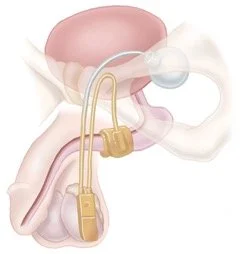
In the picture you can see the cuff placed around the urethra, the pump within the scrotum, and the pressure regulating balloon next to the bladder.
The goal is to correct the urinary incontinence, ideally so a patient no longer needs any urinary incontinent pads or diapers.
The artificial urinary sphincter is a safe procedure with minimal bleeding risk or concerns from anesthesia. Complications occur from the components of the sphincter and the pressure of the cuff on the urethra.
Infection: If the device becomes infected at any time most often it requires removal of the entire device because infections do not clear with a foreign body in place.
Urethral Injury or Erosion: The urethra is a thin and delicate structure. The cuff is placed around the urethra and puts a controlled but steady pressure on the tissue. Over time the urethra can thin, sometimes the cuff erodes through the thin area. If the urethra is injured at the time of surgery or erodes with time the device will need to be removed to allow the urethra to heal.
Continued Incontinence: Because of the limitations to how much pressure can be placed on the urethra some patients will have continued leakage of urine.
Replacement or Revision of Device: The device can break down with time, requiring replacement or revision of the components for continued success of the surgery.
Non-surgical options exist for controlling incontinence
Yes, this is a common procedure.
This is a procedure that is elective. Do the procedure when you are ready. Most patients will wait some time to see if the urinary incontinence resolves. Because of the potential complications of the procedure most patients will put off the procedure until they are sure they are ready for the surgery. That said, this procedure can be. a life-changer for patients. Some of my happiest patients are those with successful artificial urinary sphincter placement
You will stay in the hospital one night. You will avoid heavy physical activity for several weeks after the operation. You will eat a regular diet and resume normal medication.
You will be given an antibiotic to take for prevention of infection.
Your sphincter will be deactivated (not turned on) for six weeks after the operation. You will continue to be incontinent until the sphincter can be activated to allow the pressure to fill the cuff around the urethra to control urine.
The standard recommendations exist for preoperative clearance with the primary physician and any specialists you see. You will stop blood thinning agents. You will not need any bowel preparation. You will be asked to cleanse your skin with Hibiclens soap for one week prior to the surgery.
Yes, this is covered by insurance.
www.fixincontinence.com is the Boston Scientific website for men considering this operation